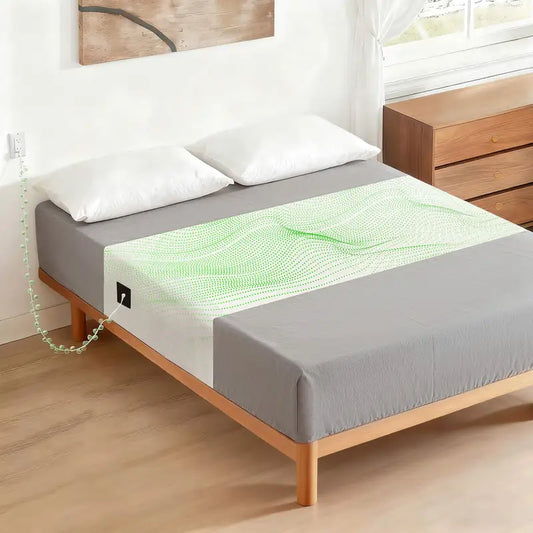
Fitted Grounding Sheets vs. Half-Sheets: Coverage and Bed-Making
Choose a fitted grounding sheet if you want to replace your bottom sheet with a broad contact surface that stays wrapped around the mattress. Choose a grounding half-sheet if you want to keep your current bedding and add a movable strip. For a home bed used over the long term, the fitted sheet is a practical choice: its corners help keep it in place and simplify bed-making. For travel or a first experience with grounding bedding, the half-sheet is easier to pack and reposition; suitable clips help reduce shifting.
The useful question is how each format fits the bed you already make. Think about your mattress layers, where bare skin rests, and how much adjustment you want to do at bedtime. Here is a practical comparison of our earthedin fitted sheet and half-sheet, followed by a routine for checking your setup.
Compare the changes to your bed
| Bed-making decision | Fitted grounding sheet | Grounding half-sheet |
|---|---|---|
| What changes? | Replaces your usual fitted bottom sheet | Adds a strip over your existing bedding |
| Where is the contact surface? | Across the mattress top | In a selected area, such as beneath bare calves or feet |
| How does it stay in place? | Fitted corners wrap around the mattress | Use suitable sheet clips to help reduce shifting, with any available fabric tucked in |
| What determines fit? | Mattress width, length, and total height | Placement, top span, side drops, and fabric left for tucking |
| What happens when you change beds? | Check the new mattress dimensions | Reposition the strip and check its fastening and connection |
| Best starting point | Long-term, everyday use on a home bed | Keeping favorite bedding, travel, or trying a smaller contact area |
When a fitted sheet makes the simpler home setup
Our fitted grounding sheet becomes the bottom sheet you sleep on. Its fitted corners help hold the fabric around the mattress, so you do not have a separate loose strip to position each night. That makes it a practical choice for long-term use on a home bed you want to remake in a familiar way.
The broader surface also gives bare arms, legs, or feet more places to touch as you change position. You still need some direct contact, but you have more flexibility about where it happens. If a narrow strip would need frequent repositioning to meet your usual sleeping position, full mattress-top coverage is the more practical starting point.
Fit comes first. Measure the mattress width and length, then the assembled height with any topper or protector you plan to keep beneath the sheet. Compare all three with the selected size and pocket depth. A wider sheet does not solve a pocket that is too shallow. Our mattress measurement guide covers that decision in detail.
When a half-sheet fits your existing routine
Our grounding half-sheet measures approximately 104.3 × 23.6 inches (265 × 60 centimeters). It is a narrow textile strip, rather than a fitted layer. Lay it over your usual bedding where bare skin naturally rests; you can keep the fitted sheet you already like.
This arrangement is useful when replacing the whole bottom sheet is not your priority. It also lets you try a particular contact position before reorganizing your bedding. At home, choose the exposed strip's position around your usual posture. When traveling, fold it with the cord and plan the connection at your destination.
For a more secure arrangement, we recommend using suitable sheet clips to help keep the half-sheet from shifting. Allow enough fabric for the sides and tuck in any available excess. The full 104.3-inch length is not all available on the mattress top. A wide or tall bed uses more fabric before any tuck is made. Clips help with fastening; they do not add fabric or increase the exposed area.
Arrange the layers around skin contact
With a fitted sheet, the conductive fabric is the exposed bottom sleeping layer. With a half-sheet, your regular fitted sheet stays underneath the strip. A protector or topper beneath either arrangement does not replace the need for skin to touch the conductive surface above it. Include those layers when checking fitted-sheet depth or the half-sheet's side drops.
Keep an ordinary sheet from becoming a barrier between your skin and the intended contact area. Bedding above your body is a different situation: you can arrange your usual covers while leaving bare calves, feet, or arms against the conductive fabric. Pajamas can work with either format when some skin remains in contact.

The diagram shows the bedding arrangement only. Its shapes are not to scale and do not show wiring or product hardware. View the full-size diagram.
Make a quick check before the first night
Use your normal sleeping position to judge the arrangement, rather than how tidy it looks when the bed is empty.
- Set the layers. Fit the full sheet around the mattress, or place the half-sheet over your existing fitted layer. Smooth the fabric without stretching it to force a fit.
- Check your usual position. Lie down and turn as you normally would. Notice whether the intended area remains under some bare skin or whether a sock, pajama cuff, or extra sheet moves between them.
- Check the hold. Recheck the fitted corners, or the half-sheet's tucks and suitable clips. If a strip shifts away, adjust its position and fastening before settling on that setup.
- Check the connection separately. Follow the supplied instructions with the matching cord and a verified grounded outlet. Keep the cord free from strain. If household grounding is uncertain, have it checked by a qualified electrician.
For a shared bed, check where each person actually lies if both intend to use the surface. A strip crossing the mattress does not automatically mean both people will touch it. The relevant detail is each person's contact with the exposed fabric.
Plan for laundry day and changing locations
The fitted format becomes part of your usual bed-linen change. After washing and drying, refit the corners and reconnect as instructed. The half-sheet is an additional piece to remove, launder, and secure again; its advantage is that the rest of your preferred bedding can stay in the arrangement.
For both current earthedin textile formats, disconnect the cord before washing, use mild neutral-pH liquid detergent and warm water at about 104°F (40°C), and tumble dry gently on low heat. Avoid bleach and fabric softener. Keep the complete care guide with your laundry routine, including its other detergent restrictions.
Before a trip, pack the half-sheet, cord, appropriate regional connection accessory, and suitable clips for your planned setup. Check the destination's outlet grounding rather than assuming a familiar socket or travel adapter establishes a ground. A fitted sheet can travel too, but only makes sense when you know the destination mattress measurements suit it.
Keep comfort and coverage in perspective
Both earthedin formats use a cotton-and-silver textile and are intended for comfortable, extended sleep use. Choose the arrangement that feels comfortable with your own layers and stays positioned during your normal movements. The fitted sheet's broad contact surface and the half-sheet's portability solve different everyday needs.
More available contact area is a practical placement advantage, not evidence of better sleep or medical outcomes. Likewise, an electrical conductivity check does not measure a health result. This comparison helps you choose a bedding arrangement; it does not rank the two formats by a guaranteed effect.
Frequently asked questions
Is a half-sheet half the size of every mattress?
No. The name describes a partial-coverage format. Our half-sheet has one listed rectangular size, approximately 104.3 × 23.6 inches. The exposed area depends on its position and the fabric used at the sides and underneath.
Do I need to replace my usual fitted sheet?
Yes when choosing the fitted grounding format as your bottom sheet. With the half-sheet, keep your existing fitted sheet and place the strip above it where bare skin can touch the conductive fabric.
Does the half-sheet need clips?
We recommend using suitable sheet clips to help hold the half-sheet in place and reduce shifting. Use any available tuck as well, following the bedding and accessory instructions. Clips are for fastening, not electrical connection; a clip set is not assumed to be included.
Which format should I choose if I move around at night?
Start with the fitted format if broad coverage and fitted corners match your needs. If you prefer a half-sheet, check your usual positions before deciding where to secure it. Choose based on the contact you can comfortably maintain.
Choose the change you want to make
For long-term everyday use on a home bed, start with our fitted sheet and match the size to your mattress stack. To keep your bedding or pack a portable contact strip, explore our half-sheet and plan its placement and clips. Choose the format you can set up comfortably, remake easily, and care for consistently.