Grounding Sheet Size Guide: Measure Your Mattress Before You Buy
A sheet that fits your bed starts with the mattress you actually sleep on, not just the size printed on its tag. A topper, a deeper mattress, or an unusually long bed can change what works. For a fitted grounding sheet, you need the mattress width, length, and total height. For a half-sheet, you need to decide where the strip will lie and how much of its length can be tucked in.
This guide turns those measurements into a practical choice between earthedin's fitted sheet and half-sheet. It is a closer look at fit than our broader guide to choosing grounding sheets.
Measure the bed as you will make it
Take off loose bedding, but leave in place any topper or mattress cover that will stay beneath the fitted sheet. Use a flexible tape measure and record three numbers in inches. Measure the mattress, not the bed frame or headboard.
| Measurement | Where to measure | Why it matters |
|---|---|---|
| Width | Across the top, from one side edge to the other | Must match the fitted sheet's listed width |
| Length | Along the top, from the head edge to the foot edge | Distinguishes, for example, a 75-inch bed from an 80-inch bed |
| Total height | From the bottom of the mattress to the top of any topper you will keep | Compare with the fitted sheet's listed pocket depth |
If a topper extends to the edges, include it in the height measurement. If the bed has a pillow top or is uneven, measure at more than one corner and use the greatest height you find. Write your result as width × length × total height. A note such as 60 × 80 × 10 inches is much more useful at checkout than “Queen bed.”
The height is easy to miss. A 9-inch mattress with a 3-inch topper creates a 12-inch stack for the fitted sheet to cover. Measuring the bare mattress alone would understate what the corners need to wrap around.
Match a fitted sheet to all three measurements
Our earthedin fitted grounding sheet replaces your usual fitted sheet. The available sizes have the following mattress footprints and pocket depths. The 80-inch-long options at 39 and 54 inches wide are Twin XL and Full XL.
| earthedin fitted size | Listed width × length | Listed pocket depth |
|---|---|---|
| Single | 35 × 75 in | 12 in |
| Twin XL | 39 × 80 in | 12 in |
| Full XL | 54 × 80 in | 12 in |
| Queen | 60 × 80 in | 12 in |
| King | 78 × 80 in | 13 in |
| California King | 72 × 84 in | 13 in |
Start by matching your width and length to a row. Then compare the measured total height with that row's pocket depth. Do not substitute a familiar bed-size label for the numbers: in this listing, the King width is 78 inches, so a mattress you call King still needs its own measurement.
For example, a 60 × 80 × 10-inch bed points to the listed Queen: its top dimensions match and its height is below the 12-inch pocket depth. A 60 × 80 × 14-inch bed does not match that pocket depth. Moving to a wider size would change the top fit without solving the depth mismatch. A half-sheet may be a better way to keep your existing fitted bedding on that taller bed.

Check what a topper changes
Measure the full stack with the topper in place. If you sometimes remove it, note both heights; the sheet has to fit the arrangement you will use most often. A thin mattress protector may add little height, while a thick topper can move you past a pocket-depth limit. The important number is the assembled height, not the topper's advertised thickness on its own.
If your width and length match a fitted-sheet option but the assembled height exceeds that option's depth, keep the bedding you know fits and consider the earthedin half-sheet for a separate contact area. Its fit depends on placement and available fabric for tucking, not on a fitted corner or pocket.
Work out the half-sheet's usable span
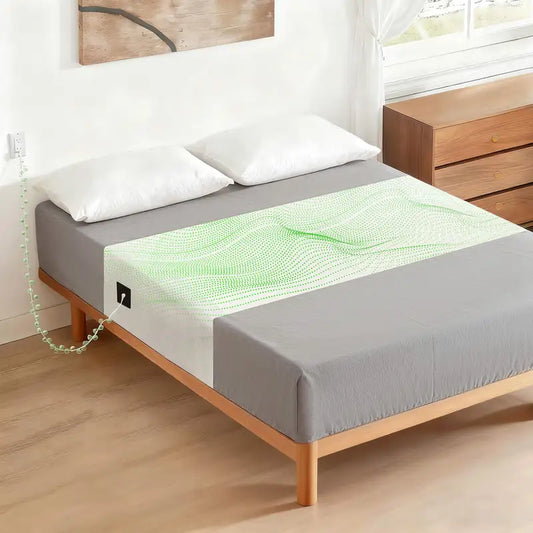
Our half-sheet is listed at 104.3 × 23.6 inches (265 × 60 cm). The long dimension can run across the mattress or along it. The shorter dimension makes a strip rather than a full fitted surface. Its 104.3-inch overall length is not the same as 104.3 inches lying flat on top of the bed: fabric also goes down the sides and under the mattress to hold the strip in place.
Use this simple length budget for the direction you want to lay it:
Overall half-sheet length = top span + side drop on each end + fabric tucked under each end.
Suppose you lay the strip across a bed that is 60 inches wide and 10 inches high. The top and two sides use about 80 inches (60 + 10 + 10), leaving about 24.3 inches total before tucking. If centered, that is about 12.15 inches per side to arrange under the mattress. Allow for your bedding layers and the way you position the strip when planning that tuck.
Now consider a 78-inch-wide, 12-inch-high bed. The top and two sides would use about 102 inches, leaving only 2.3 inches total for both tucks. That makes a cross-bed tuck much less practical. The calculation is why “one size” does not mean the same amount of exposed fabric or tuck on every bed. For a 78 × 80 × 12-inch mattress, the listed King fitted sheet is a more promising starting point: its top matches and its pocket depth is 13 inches.
The half-sheet is intended to sit over your existing bedding with its contact area exposed for skin contact. Choose its position based on where you lie and how you make the bed; do not count fabric hidden at the sides or underneath as contact area.
If your mattress is between listed sizes
Use the actual measurements to find the mismatch. A 54 × 80-inch bed is a different length from a 54 × 75-inch bed, even if both are casually called Full. A deeper mattress is a depth problem, not a reason to buy a wider fitted sheet. A bed frame that adds inches to the outside of the bed does not add inches to the mattress itself.
When no fitted row matches all three measurements, the half-sheet gives you a way to keep a fitted sheet that already works. Measure the intended top span and use the length budget above to see how much fabric remains for the sides and tucks. If the calculated remainder is too small for your preferred arrangement, choose a different placement or a bedding format with dimensions that suit your bed.
A quick check before ordering
Keep these four details together so you can compare the product with your actual bed:
- Your measured width, length, and assembled height. Include the topper and any layers you plan to keep under a fitted sheet.
- Your preferred format. Choose fitted if you want to replace the full fitted layer; choose the half-sheet if you want to retain it and add a strip.
- Your planned half-sheet orientation. Calculate the top span, two side drops, and fabric left for tucking.
- The terms that matter to you. Review the current earthedin return policy before ordering, especially if fit is uncertain.
A brief note on evidence
Small preliminary studies have explored sleep-related outcomes with conductive pads or mats. Their sample sizes, populations, and equipment differ from a retail fitted sheet, so they cannot guarantee results for a particular earthedin product. A conductivity check measures an electrical property, not sleep quality or a medical outcome. For more context, see the research section of our buyer’s guide.
Frequently asked questions
Should I measure the mattress with the topper on?
Yes, if the topper will stay under the fitted sheet. Measure from the bottom of the mattress to the top of the topper and compare that combined height with the listed pocket depth.
Is Twin XL the same length as Twin?
No. earthedin's Twin XL size details give 39 × 80 inches. A shorter 75-inch mattress is not the same footprint. Measure the length instead of relying on the word “Twin.”
Will a half-sheet fit any mattress height?
Its length must cover the top span, the drops down both sides, and enough fabric for your chosen tuck. A taller or wider bed uses more of that length before tucking, so calculate with your own measurements.
Should I size up if my fitted-sheet pocket is too shallow?
Not automatically. A wider sheet changes the top fit. If your mattress height is greater than the listed pocket depth for the matching width and length, consider the half-sheet or another fitted option with an appropriate depth.
Choose the format that fits your bed
With your three measurements in hand, compare them with the earthedin fitted sheet's dimensions. If the top matches but your stack is too deep, use the length calculation to see whether the earthedin half-sheet suits your placement. The right next step is the format you can arrange on your own bed with a comfortable, stable fit.