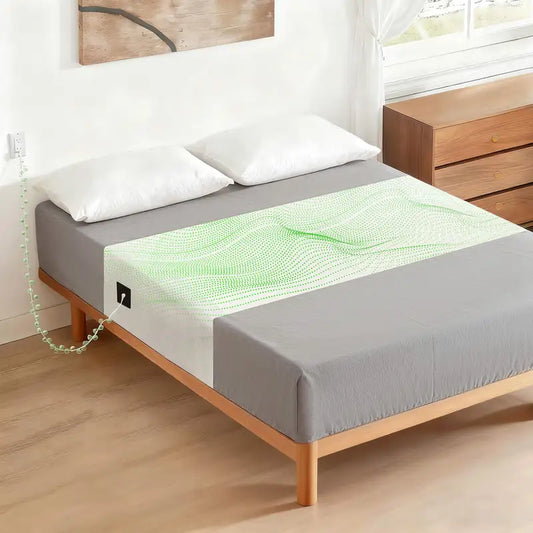
Grounding Sheets Explained: Setup, Connection, and Regional Plugs
A grounding sheet setup has three essentials: a conductive surface that touches your skin, a compatible grounding cord, and a verified earth connection. Understanding what each part does makes choosing a plug and arranging the bed more straightforward.
Our homepage guide introduces the setup, the connection, and your regional plug. Here, the same three illustrations accompany practical explanations, with additional details you can expand as you go. Start with the bed, follow the connection, then match the accessory to the socket where you will use it.
THE GROUNDING GUIDE

Start with the setup
The sheet format
Choose our fitted grounding sheet to replace your current fitted sheet and cover the mattress top. Choose our grounding half-sheet to keep your current fitted sheet and add a narrower contact area over it. The difference is how you make the bed and where the contact surface sits.
The skin contact
Arrange the conductive surface for direct skin contact. A bare arm, leg, or foot can touch it while you wear your usual sleepwear; your whole body does not need to be uncovered. With a half-sheet, leave the contact area exposed above your ordinary fitted sheet.
The grounding cord
Use the cord supplied for your product and the appropriate regional connector. Its intended connection is to the outlet's earth contact rather than the live and neutral contacts that power appliances. The sheet is not an electric blanket with a heating setting.
Setup details
For a fitted sheet, match the mattress width, length, and total depth, including any topper. Our grounding sheet size guide explains those measurements. For a half-sheet, position it across the bed where exposed skin can rest on it, and use the available length to tuck the ends securely.
Keep a duvet or blanket above you, rather than between your skin and the conductive surface. A fabric being cotton or feeling thin does not, by itself, establish a connection through it. Direct contact keeps this part of the setup clear.
Connect the sheet end securely and leave enough slack for normal movement without pulling on the connector. A phone charging cable, improvised wire, or unrelated adapter is not a substitute for the supplied accessory. Choose the format for your bedding preferences; greater coverage does not establish a stronger health effect.

Understand the connection
The outlet contact
The intended bedside path is skin → conductive sheet → supplied cord and regional connector → outlet earth contact. An outlet's appearance does not verify that its grounding connection is present and working.
The building's grounding system
The outlet connects to the building's protective grounding system. Grounding conductors and bonding connections belong to its electrical installation; they do not bypass it. OSHA's grounding explanation distinguishes equipment grounding from the system ground.
The earth connection
The building's arrangement establishes its connection to earth. The illustration simplifies this relationship; actual buildings do not all use one wire ending at one rod outside a bedroom window. Use the diagram to understand the parts, rather than as a wiring or ground-rod installation guide.
Outlet and connection checks
Before connecting the sheet, use an outlet tester intended for your country's socket system and follow its own instructions and indicator chart. Light colors and patterns differ between models. If the result indicates a fault or is unclear, leave that outlet out of use for the sheet and have a qualified electrician assess it.
A basic tester screens for certain common wiring faults, not every installation problem. Klein Tools' receptacle tester documentation, for example, states that its tester does not determine ground quality and cannot detect some combinations of faults.
In the US, a GFCI receptacle can be installed where no equipment ground exists, with the required labeling. A GFCI provides a form of shock protection but does not create a missing ground. OSHA's wiring requirements explain this distinction. A receptacle labeled “No Equipment Ground” is unsuitable for this connection.
Focus on compatible accessories, an intact path, and a properly checked outlet. Inserting a connector alone does not establish that the whole path is sound or guarantee that your body remains at exactly the Earth's surface potential.

Find your regional plug
Match the intended socket
Choose the regional option for the socket where you plan to use the sheet, rather than for your shipping address alone. Our fitted sheet and half-sheet currently list USA/CA, UK, and AU/NZ as purchase options.
Preserve the earth connection
Mechanical fit and electrical grounding are separate checks. An adapter can fit while omitting the earth connection. Electrical Safety First's travel adapter guidance explains this problem with some adapters.
Understand the European example
The homepage illustration includes an EU Schuko socket as a regional example. Europe does not have one universal socket system. Match the actual socket and a product-compatible grounding accessory; a simple two-pin travel adapter does not necessarily preserve grounding.
Regional plug details
| Where you will use the sheet | earthedin option | What to match |
|---|---|---|
| United States or Canada | USA/CA | A compatible outlet with a checked grounding contact; a two-slot outlet alone has no grounding contact. |
| United Kingdom | UK | The supplied UK accessory and a compatible, checked UK socket. |
| Australia or New Zealand | AU/NZ | The supplied AU/NZ accessory and a compatible, checked local socket. |
For European sockets, some systems provide earth through side contacts or a separate pin. SKROSS's plug-type reference distinguishes unearthed Type C from earthed Type E and F connections. The pictured socket is not a universal compatibility promise: the socket, accessory, and earth path must work together.
Use a grounding accessory explicitly compatible with your product and destination socket, rather than an arbitrary travel adapter. When traveling, repeat the outlet and compatibility checks at your destination. A successful setup at home does not verify a hotel or another household's wiring.
4. Make the final bedside checks
Before use, check that the sheet and cord are dry, the connectors are secure, and the cord has no visible damage. Keep it clear of walking routes, moving bed mechanisms, and furniture that could pinch it. These checks follow general cord-care principles in WorkSafe New Zealand's guidance.
After washing or rearranging the bed, reconnect according to the product instructions and check the contact area again. If something changes, work through the physical setup rather than judging the connection by a sensation.
| What you notice | What to do next |
|---|---|
| The cord comes loose during bed-making | Reconnect it securely and adjust the route so movement does not pull on it. |
| Your skin rests on another sheet or a blanket | Reposition the conductive surface for direct contact with exposed skin. |
| An outlet tester shows a fault or an unclear result | Stop using that outlet for the sheet and arrange an electrical assessment. |
| You want to check the sheet itself | Use a compatible product tester according to its instructions; an outlet tester does not test the fabric. |
What a connection check tells you
An outlet check and a compatible sheet test answer electrical setup questions. They do not measure sleep improvement or establish a medical benefit. Our practical buyer's guide also explains how product specifications differ from health evidence.
Frequently asked questions
Can I use a grounding sheet in an apartment?
Yes, if the intended outlet has a properly verified grounding connection and is compatible with the supplied accessory. Being on an upper floor does not itself determine whether an outlet is grounded. The building's installation is what matters.
Can I keep my ordinary fitted sheet?
Yes. Choose a half-sheet and place it over your existing fitted sheet, with the conductive contact area exposed. To replace the fitted sheet itself, choose the fitted format instead.
Can a travel adapter add grounding to a two-slot outlet?
No. Changing the connection's shape does not create a grounding path that the outlet lacks. Use a suitable verified grounded outlet and compatible product accessory.
Should I install my own ground rod if the outlet is unsuitable?
This guide does not cover a separate ground-rod setup. Have a qualified electrician assess the outlet rather than improvising a connection to plumbing, a radiator, or a new electrode. Use arrangements supported by the product instructions and appropriate electrical assessment.
Choose a setup that fits your room
Choose the fitted grounding sheet to replace your current fitted sheet, or choose the grounding half-sheet to keep it and add a contact area. Match the regional option to your intended socket, verify the outlet, and arrange the supplied cord and skin-contact surface. These are the practical pieces of a complete setup.